Beat Sheet Templates: How to Organize Your Novel Beat by Beat
Learn how to use beat sheet templates to organize novel plot points, character changes, setups, payoffs, and story structure, with a practical example.

Read-aloud is not available in this browser.
A novel can have a strong premise, compelling characters, and a solid outline and still become difficult to write somewhere around the middle.
Often, the problem is not the story itself. It is the gap between the big-picture plan and the individual scenes. You may know that your protagonist discovers the truth halfway through the book, suffers a major defeat near the end of Act Two, and confronts the antagonist in the climax. What you may not know is what needs to happen between those landmarks.
That is where beat sheet templates become useful.
A beat sheet breaks the story into significant moments of change: decisions, discoveries, reversals, complications, emotional shifts, and turning points. It gives you more detail than a structural framework without forcing you to plan every scene before you begin.
Used well, a beat sheet becomes a practical bridge between outlining and drafting.
What Is a Beat Sheet?
A beat sheet is a chronological list of meaningful story developments.
The important word is meaningful. A beat changes the direction of the plot, alters what a character knows, increases pressure, affects a relationship, or forces a decision.
Consider Pride and Prejudice:
- Elizabeth Bennet meets Mr. Darcy.
- Darcy insults Elizabeth within her hearing.
- Elizabeth receives information that reinforces her dislike of him.
- Darcy unexpectedly proposes.
- Elizabeth rejects him.
- Darcy’s letter forces Elizabeth to reconsider her judgment.
These are not simply events. Each changes Elizabeth’s understanding, relationships, choices, or expectations.
By contrast, “Elizabeth walks downstairs” is not normally a useful beat. Unless the action changes something that matters, it belongs in the scene rather than the beat sheet.
Why Beat Sheet Templates Matter
Novel planning usually happens at several levels.
At the highest level, you have a premise, character arcs, and perhaps a framework such as Three-Act Structure, Save the Cat, or the Hero’s Journey. Those tools identify the shape of the story.
Eventually, though, you have to turn that shape into 80,000 words.
Suppose a thriller contains these structural landmarks:
- A murder opens the novel.
- The investigator takes the case.
- A midpoint revelation changes the investigation.
- The investigator becomes the next target.
- The story ends in a final confrontation.
That is a useful skeleton, but it does not tell you what happens through several dozen chapters.
A beat sheet might reveal the chain beneath it:
- A body is discovered beside an abandoned railway line.
- The detective notices evidence suggesting the victim knew the killer.
- The victim’s husband supplies a convincing alibi.
- A witness contradicts part of his story.
- CCTV proves the witness was lying too.
- The detective realizes both men are protecting someone else.
- The investigation connects to an unsolved disappearance fifteen years earlier.
Now the story has momentum, and you can inspect that momentum before reaching Chapter 19 and realizing very little has happened since Chapter 11.
What Should a Beat Sheet Template Include?
There is no single correct beat sheet template. A discovery writer may need only a handful of major developments. A detailed plotter may want considerably more.
For most novels, however, the following information is useful.
Beat name
Give each beat a short working title:
- Anna Finds the Letter
- Second Body Discovered
- Marcus Refuses the Offer
- The Kiss
- Betrayal Revealed
The title only needs to help you find the beat quickly.
What happens
Summarize the development in one or two sentences.
Too vague:
Mary and Rob argue.
More useful:
Mary confronts Rob about the missing money. He denies taking it but accidentally reveals that he knows where the account was held.
The second version identifies what actually changes.
Why the beat matters
Ask one question:
What changes because this happens?
A beat might reveal information, force a decision, increase danger, change a relationship, introduce a mystery, close off an option, or resolve an earlier question.
If you cannot explain why the beat matters, it may not belong in the plan.
Character goal
What does the viewpoint character want at this moment?
For example:
Beat: Police question Daniel.
Goal: Prevent them from discovering that he saw the victim on the night she died.
The character is no longer passively moving through the plot. He has something to protect.
Conflict or complication
What makes the goal difficult?
Conflict can come from another character, missing information, time pressure, fear, social expectations, physical limitations, a moral dilemma, or two desirable outcomes that cannot coexist.
Recording the source of pressure is particularly useful for spotting scenes that exist only to deliver information.
Outcome
Record what is different at the end.
Before: The detective trusts the witness.
After: The detective knows the witness has lied.
If several consecutive beats leave the situation essentially unchanged, the story may be circling rather than advancing.
A Simple Beat Sheet Template
You do not need an elaborate system. Start with this:
| Field | What to Record |
|---|---|
| Beat | Short descriptive name |
| Story position | Act, section, or approximate percentage |
| POV character | Character experiencing the beat |
| Goal | What the character wants |
| Event | What happens |
| Conflict | What makes the goal difficult |
| Outcome | How the situation changes |
| Purpose | Why the beat belongs in the novel |
| Setup/payoff | Anything planted or resolved |
| Notes | Questions, research, or drafting reminders |
For an early outline, you can reduce this to three fields:
Beat → What happens → What changes
Add detail only when it solves a planning problem.
Example Beat Sheet Template in Practice
Imagine a mystery about Lena, a journalist who returns to her coastal hometown after her father dies.
Beat 1: Returning Home
Goal: Clear her father’s house quickly and return to London.
Event: Lena discovers that her father left one room locked.
Conflict: She cannot find the key.
Outcome: She reluctantly extends her stay.
Purpose: Establishes the mystery and prevents her immediate departure.
Setup: Locked room.
Beat 2: The Old Photograph
Goal: Find the missing key.
Event: Lena searches her father’s study and finds a photograph of him with an unfamiliar woman.
Conflict: The photograph is dated three years after Lena’s mother supposedly died.
Outcome: Lena begins questioning what she knows about her father’s past.
Purpose: Turns a practical mystery into a personal one.
Setup: Unknown woman.
Beat 3: Someone Has Been Inside
Goal: Ask a neighbor whether they recognize the woman.
Event: Lena returns home and finds the study disturbed.
Conflict: Nothing appears to be missing except the photograph.
Outcome: She realizes someone else cares about her father’s secrets.
Purpose: Introduces external opposition and raises the stakes.
Payoff: Photograph from Beat 2.
Each beat creates the conditions for the next. That cause-and-effect chain is what makes the sheet useful.
Beat Sheets and Story Structure Are Not the Same Thing
A structural framework is not a complete beat sheet.
Three-Act Structure identifies major turning points. Save the Cat includes named structural beats such as Catalyst, Midpoint, All Is Lost, and Finale.
Those beats are landmarks.
Your working beat sheet provides the road between them.
A framework might tell you:
Midpoint: The protagonist discovers that the apparent villain is innocent.
Your novel may still need ten intermediate developments leading toward and away from that revelation.
Think of structure as the shape of the journey. The beat sheet records the meaningful steps through it.
Common Beat Sheet Template Mistakes
Recording activity instead of change
“Sam drives to the hospital” probably does not need to appear.
“Sam decides to visit the hospital despite being forbidden from seeing his daughter” probably does.
Prioritize decisions, discoveries, reversals, consequences, and changing circumstances.
Treating every beat as equally important
A small relationship shift and the midpoint revelation may both belong on your beat sheet, but they do not carry equal structural weight.
Make major turning points easy to identify.
Confusing beats with chapters
A chapter may contain several beats. A beat may occasionally extend across several scenes.
Do not force a one-beat-per-chapter system unless the story genuinely supports it. Plan the progression first; decide where chapter breaks belong afterward.
Turning the beat sheet into a draft
If every beat contains several paragraphs of dialogue, description, blocking, and emotional interpretation, you are no longer outlining.
Record enough to understand the development. Leave the scene itself for the manuscript.
Treating the template as a contract
The manuscript outranks the plan.
If Chapter 14 proves that your protagonist would never make the decision you planned three months earlier, change the beat sheet rather than forcing the character to obey it.
How to Keep Your Beat Sheet Updated
A beat sheet becomes even more useful during drafting if it reflects the novel you are actually writing.
Update it when the manuscript meaningfully departs from the plan.
If a revelation moves earlier, revise later beats that depended on it. If you remove a subplot, check whether future events still rely on it. If you introduce a clue in Chapter 6, record where it will pay off.
It also helps to distinguish planned beats from completed beats. Once you draft a section, revise its beat description to reflect what actually happened.
By revision time, the sheet becomes both a planning tool and a compact record of the manuscript.
Digital Beat Sheet Workflows
Beat sheets work in several formats.
A spreadsheet is useful when you want to sort beats by POV character, act, subplot, or status. Index cards suit writers who prefer physically rearranging the story. A simple document works perfectly well for a chronological list.
Novel-planning software can reduce duplication by keeping beats closer to the chapters, scenes, characters, and structural framework they affect.
In Scryla, for example, you might use the story structure as your high-level framework while developing the detailed progression through chapters and scenes. You can also track character arcs, setups and payoffs, and pacing alongside the outline.
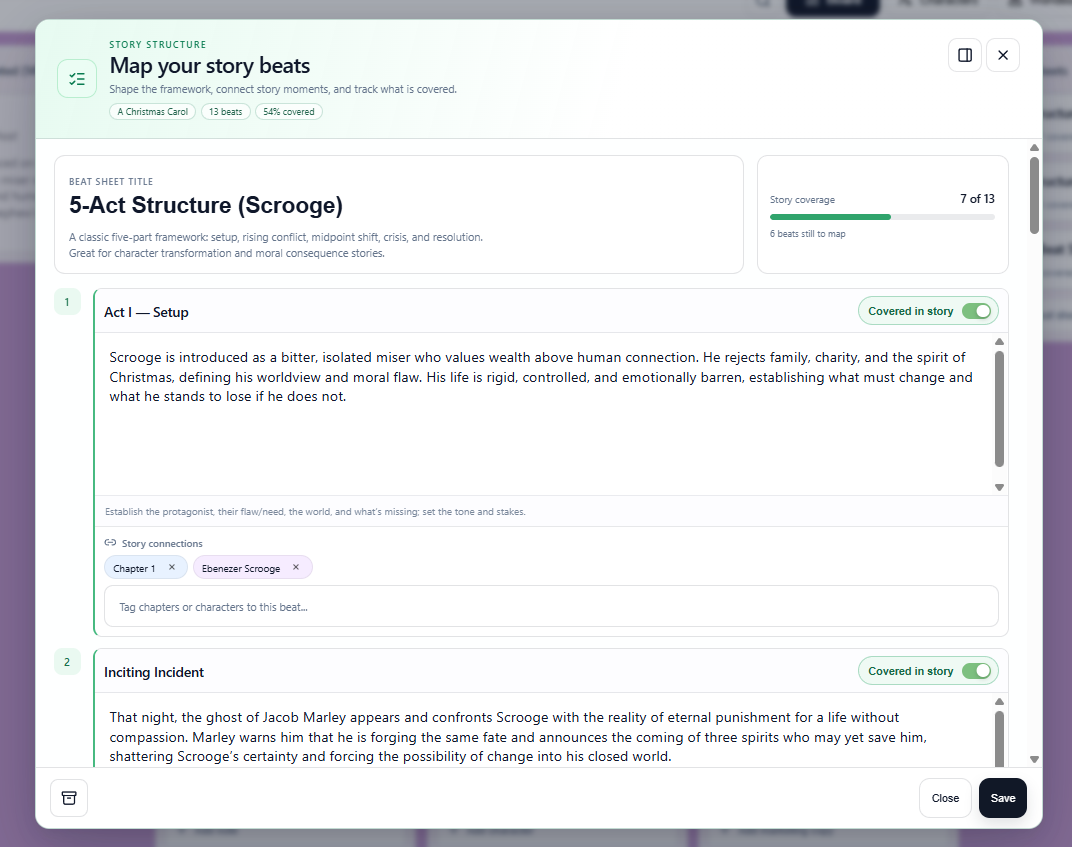
The main advantage is not that the plan is digital. It is that you have fewer disconnected versions of the same story to keep synchronized.
Printable Beat Sheet Checklist
Story progression
- Each major beat changes the situation.
- Important decisions have visible consequences.
- Major discoveries affect later events.
- Stakes develop rather than remaining static.
- The middle contains meaningful developments rather than filler.
- Major structural turning points are easy to identify.
Character movement
- Viewpoint characters have clear goals during important beats.
- Opposition prevents those goals from being achieved too easily.
- Major choices reflect established motivations.
- Relationship changes affect later beats.
- Character arcs develop alongside the external plot.
Story logic
- Important developments have believable causes.
- Setups appear before their payoffs.
- Reveals are supported by information available to the reader.
- Removed beats have not left later developments unsupported.
- Subplots eventually affect, complement, or resolve within the main story.
Drafting usefulness
- Beat descriptions are specific enough to guide scenes.
- They are short enough to leave room for discovery while drafting.
- You can identify what changes after every important beat.
- You know which beats are fixed and which remain flexible.
- The sheet reflects the current manuscript.
How Detailed Should a Beat Sheet Be?
Detailed enough to solve the problem you have.
If you regularly know the major turning points but struggle to connect them, add more intermediate beats. If extensive planning drains the energy from the story, use fewer.
A discovery writer might begin with fifteen major beats. A detailed plotter might use fifty, eighty, or more.
The number does not matter.
Your beat sheet should answer three questions:
What happens next?
Why does it happen?
What changes because of it?
If it can do that, it is doing its job.
Practical Next Steps
Begin with the major developments you already know: the opening situation, inciting event, turning points, midpoint, late-story crisis, climax, and resolution.
Then examine the spaces between them.
For each pair of major beats, ask:
What must happen for the story to move convincingly from one to the other?
Add only the developments needed to create that chain.
Finally, test every beat with one more question:
What is different afterward?
If the answer is “nothing,” the beat may need more pressure, a clearer consequence, or removal.
A good beat sheet makes your novel easier to understand without making it feel predetermined. Once you have one, try comparing it with your chosen story structure, character arcs, and chapter outline. The places where those planning layers disagree are often where the most useful revision work begins.