Freytag’s Pyramid: A Guide for Novelists
Learn how Freytag’s pyramid works, explore its five stages, study a classic novel example, and discover when to use another story structure.

Read-aloud is not available in this browser.
A strong story does more than arrange events in sequence. It builds pressure, reaches a decisive turning point, and follows the consequences to a meaningful conclusion.
Freytag’s pyramid offers a simple way to understand that dramatic movement. It divides a story into five stages:
- Exposition
- Rising action
- Climax
- Falling action
- Resolution
The familiar diagram shows tension climbing toward a central peak before descending toward the ending. Useful as that image is, novels rarely form perfect triangles. They contain setbacks, temporary victories, subplots, revelations, and smaller turning points.
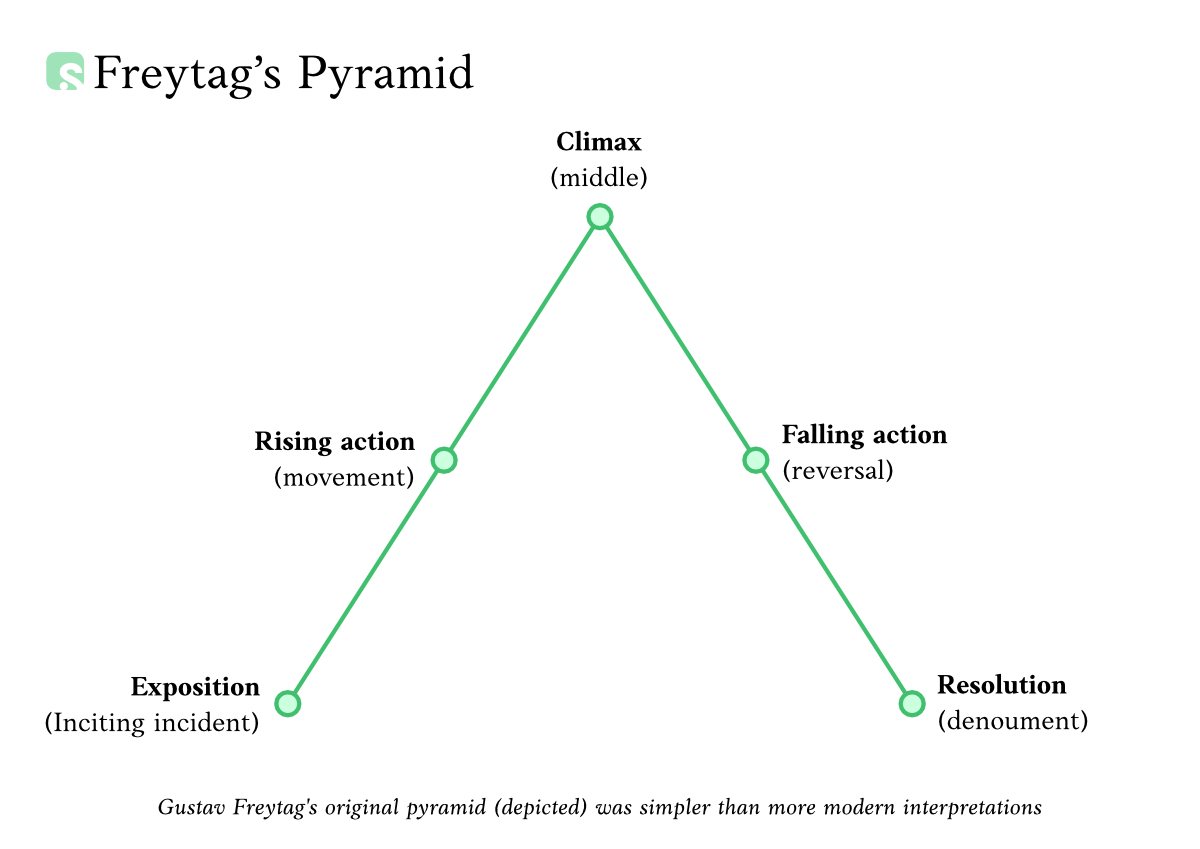
Freytag’s pyramid is therefore best treated as a map of a story’s overall movement—not a formula for plotting every chapter.
The History of Freytag’s Pyramid
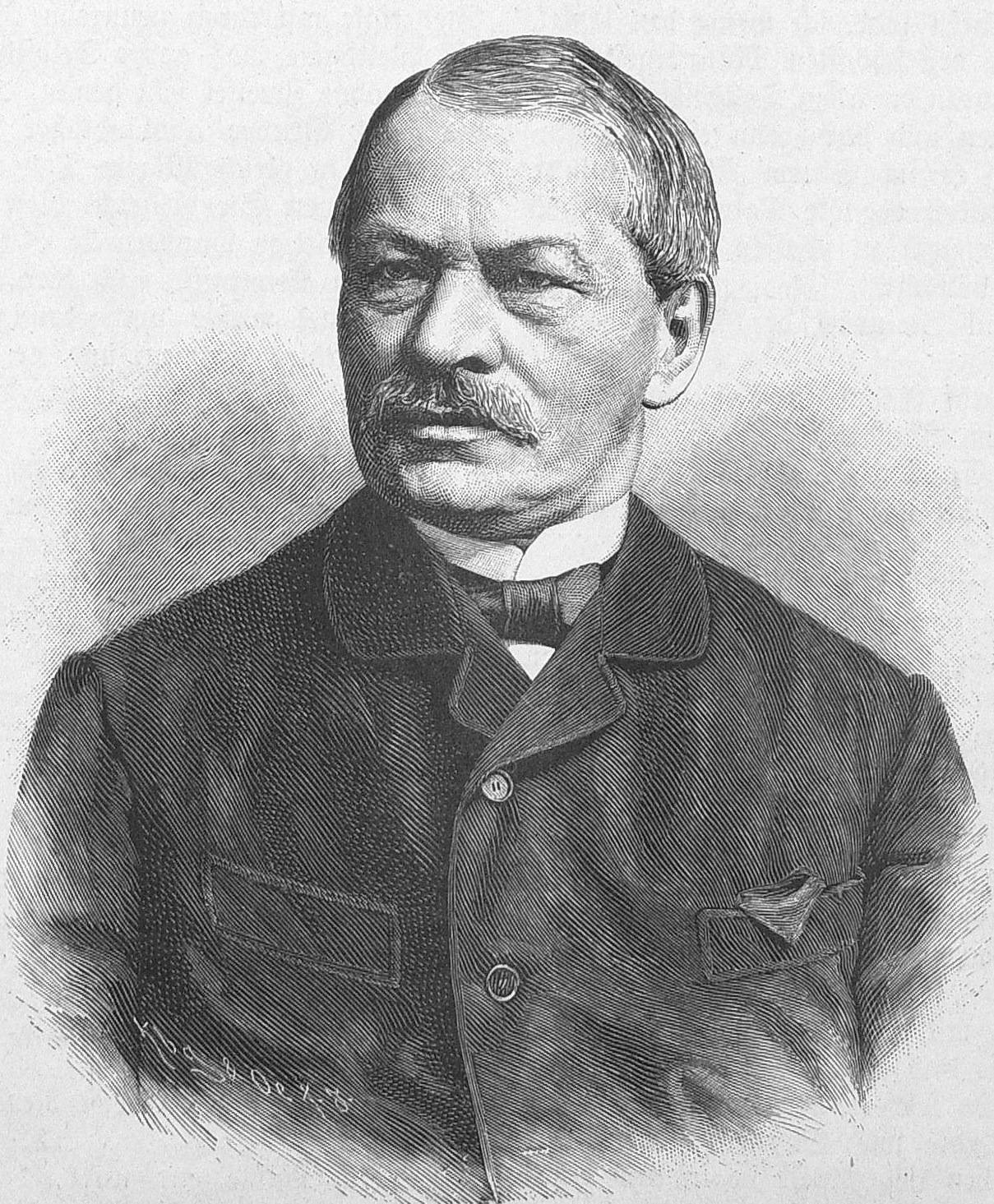
Freytag’s pyramid takes its name from German novelist and playwright Gustav Freytag. He introduced the framework in his 1863 book Die Technik des Dramas, later translated as Freytag’s Technique of the Drama.
Freytag developed his ideas by studying classical Greek drama and five-act Shakespearean tragedy. He observed a recurring pattern:
- The characters and situation are established.
- Complications increase.
- The action reaches a decisive turning point.
- The consequences unfold.
- The conflict ends in resolution or catastrophe.
His use of the word climax differs from its common modern meaning. Today, writers often use climax for the final confrontation near the end of a story. Freytag placed it closer to the center, where it marked a reversal in the story’s direction.
That distinction matters when applying the pyramid to modern fiction. A novel may have both a structural climax near the midpoint and a final climax near the ending.
Although Freytag designed the framework for drama, it is now widely used to analyze novels, films, and short stories.
What Problem Does Freytag’s Pyramid Solve?
A manuscript can contain compelling characters and dramatic scenes yet still feel flat. Often, the problem is not the individual material but the relationship between events.
Freytag’s pyramid helps writers ask:
How does the central conflict develop over time?
It can expose structural weaknesses such as:
- A main conflict that begins too late
- A middle built from repetitive obstacles
- A climax that changes nothing
- An ending that arrives immediately after the confrontation
- Early information that never becomes relevant
- A resolution that fails to show what the conflict has changed
The model encourages cause and effect. Exposition creates the conditions for conflict. Rising action develops it. The climax changes its direction. Falling action explores the consequences. Resolution establishes the new state of the story.
Core Principles of Freytag’s Pyramid
Plot Develops Through Cause and Effect
A sequence of incidents is not necessarily a plot. Major events should alter what becomes possible next.
Consider this chain:
- A character conceals a crime.
- The lie requires a false alibi.
- The alibi implicates an innocent colleague.
- The colleague discovers the deception.
- That discovery forces a confrontation.
Each choice produces the next problem. The pressure rises because the character cannot return to the original situation.
Conflict Must Escalate
Rising action requires more than additional activity. The conflict should become harder, more dangerous, more personal, or more costly.
Escalation can involve:
- Greater physical danger
- Higher emotional stakes
- Fewer available choices
- Damaged relationships
- Stronger opposition
- New information
- Shorter deadlines
- More severe consequences
A detective interviewing five uncooperative witnesses may create repetition rather than escalation. Discovering that the chief witness is protecting the killer changes the investigation.
The Climax Changes the Story’s Direction
In Freytag’s original model, the climax is the central reversal.
Before it, the story moves toward a possibility. After it, the characters must deal with what has been discovered, chosen, won, or lost.
A climax might involve:
- A victory that creates a worse problem
- A revelation that changes the protagonist’s goal
- An irreversible decision
- A betrayal
- A death
- A public exposure
- A declaration of love
- A reversal of power
The important question is not whether the scene is spectacular. It is whether the story can continue in the same direction afterward.
Falling Action Can Still Be Intense
The term falling action doesn’t mean that the story becomes dull.
What falls isn’t necessarily the tension, but the number of unresolved possibilities. Rising action creates and expands complications. Falling action begins fulfilling, resolving, or destroying them.
Resolution Establishes the New Normal
The resolution is not simply where the novel stops. It shows what remains after the central conflict has ended.
The protagonist may return home, accept a painful truth, begin a relationship, assume a new role, or face the permanent cost of failure. A satisfying resolution answers the story’s most important plot and emotional questions, even when some details remain open.
The Five Stages of Freytag’s Pyramid
1. Exposition
Exposition establishes the conditions from which the conflict will grow. It introduces what readers need to understand, including:
- The protagonist
- The setting
- Important relationships
- The current situation
- Relevant history
- The protagonist’s immediate concerns
- The rules of the story world
Exposition is not the same as backstory. It does not require several chapters of explanation before anything happens.
Effective exposition usually emerges through action. A fantasy novel might reveal the limits of magic when the protagonist fails a ritual. A mystery could establish a troubled marriage during the couple’s final public argument. A historical novel might reveal class restrictions when a servant is punished for entering the wrong room.
The Inciting Development
Freytag described an “exciting force” that begins the main action. Modern writers usually call this the inciting incident.
It disturbs the existing situation and creates a problem the protagonist cannot easily ignore. A body is discovered. A child disappears. A stranger arrives. A secret becomes public. A job offer requires someone to leave home.
Exposition ends once the central dramatic problem is underway.
Questions to Ask
- What must readers understand before the conflict escalates?
- What does normal life look like for the protagonist?
- What disturbs that normality?
- Why can the protagonist not simply walk away?
A common mistake is delaying the conflict until every detail of the protagonist’s history has been explained. Readers rarely need a complete biography before they can care about a present problem.
2. Rising Action
Rising action usually occupies the largest part of a novel. The protagonist pursues a goal, encounters resistance, makes decisions, and faces increasingly serious consequences.
The key is progression.
Imagine a journalist investigating corruption in a local council. A repetitive middle might contain several scenes in which officials refuse to answer questions. A stronger sequence could develop like this:
- An official refuses to cooperate.
- A source provides confidential financial records.
- The records implicate the journalist’s employer.
- The source disappears.
- The journalist is accused of stealing the documents.
- Publishing them would expose a close family member.
Each development changes the situation and narrows the protagonist’s choices.
Rising action should:
- Develop the central conflict
- Test the protagonist’s methods
- Reveal character under pressure
- Increase the cost of failure
- Advance important subplots
- Prepare the climax
- Force harder decisions
The protagonist does not need to lose every encounter. Temporary victories can create powerful complications. A detective may identify the killer but place a witness in danger by making an arrest. Two romantic leads may finally begin a relationship just as one accepts a job overseas.
Longer novels also need smaller reversals. An ally withdraws. False evidence collapses. A rival becomes useful. A private conflict becomes public. The protagonist changes tactics.
These turns keep the middle from becoming one long, predictable climb.
Questions to Ask
- Does each major obstacle change the situation?
- Are the stakes becoming more severe or personal?
- Is the protagonist making active choices?
- Do earlier decisions create later complications?
- Is the plot moving toward a decisive reversal?
3. Climax
In Freytag’s pyramid, the climax is the story’s central turning point. It creates a clear before and after.
A ruler may gain the throne but reveal the cruelty that will destroy the reign. A detective may prove who committed a murder but discover that the victim engineered the crime. A revolutionary may overthrow a government only to realize that an ally intends to establish another dictatorship.
The climax does not need to be loud. A quiet realization or private decision can redirect an entire novel.
Freytag’s Climax Versus the Modern Climax
This is the framework’s most common source of confusion.
In many modern story structures, the climax is the late confrontation that settles the central conflict: the final battle, courtroom verdict, rescue, confession, or romantic declaration.
Freytag’s climax often appears earlier. It is the reversal that sends the story into its next movement.
When analyzing a modern novel, it can help to distinguish between:
- Structural climax: The central reversal at the peak of Freytag’s pyramid
- Final climax: The late confrontation that resolves the main conflict
Some stories combine them. Others separate them by many chapters.
Questions to Ask
- What changes here that cannot be undone?
- What does the protagonist gain, lose, discover, or choose?
- Does the story move in a different direction afterward?
- Has the rising action prepared this moment?
- What consequences must the remaining story address?
4. Falling Action
Falling action shows what happens because of the climax.
Plans succeed or collapse. Secrets spread. Allies respond. Relationships fracture. Earlier decisions return with consequences. The story begins moving toward its final outcome.
In a tragedy, this section may trace the protagonist’s decline. In a mystery, it might show the detective using a decisive discovery to expose the culprit. In a romance, it may follow the collapse of a relationship after a central revelation.
Falling action can include:
- The antagonist gaining an advantage
- The protagonist confronting the cost of an earlier choice
- Subplots converging with the main plot
- A final plan being formed
- The darkest point
- A late confrontation
- The protagonist acting on what they have learned
Modern novels often place considerable dramatic weight here. The final climax may occur during the falling action rather than at the pyramid’s peak.
That does not make the model unusable. It simply means that modern fiction often gives more space to the consequences of the central reversal than Freytag’s original diagram suggests.
Questions to Ask
- What follows directly from the climax?
- Which earlier promises now require fulfillment?
- Are the major subplots converging?
- Is the protagonist being forced toward a final choice?
- Does every scene move the story closer to resolution?
5. Resolution
The resolution settles the central conflict and establishes the ending state.
Freytag used the word catastrophe when discussing tragedy, where the final movement often brought death, defeat, or ruin. In modern fiction, the resolution may be happy, tragic, bittersweet, ambiguous, or cautiously hopeful.
A resolution usually answers two kinds of questions.
Plot Questions
- Was the murderer caught?
- Was the kingdom saved?
- Did the couple remain together?
- Was the missing child found?
- Did the expedition succeed?
- Was the protagonist’s name cleared?
Character Questions
- What has the protagonist learned?
- Which belief has changed?
- What has the conflict cost?
- Which relationships have been transformed?
- What kind of life is now possible?
A novel may resolve its plot while leaving the protagonist emotionally unsettled. It may also provide personal closure while leaving a wider social or political conflict unresolved.
Denouement
The final portion of the resolution is often called the denouement, from a French word meaning “the untying.”
It shows the aftermath once the main conflict has ended: a funeral, a wedding, a return home, a new job, a conversation between survivors, or a final image that echoes the opening.
The denouement should provide enough space for emotional completion without making the novel appear to end several times.
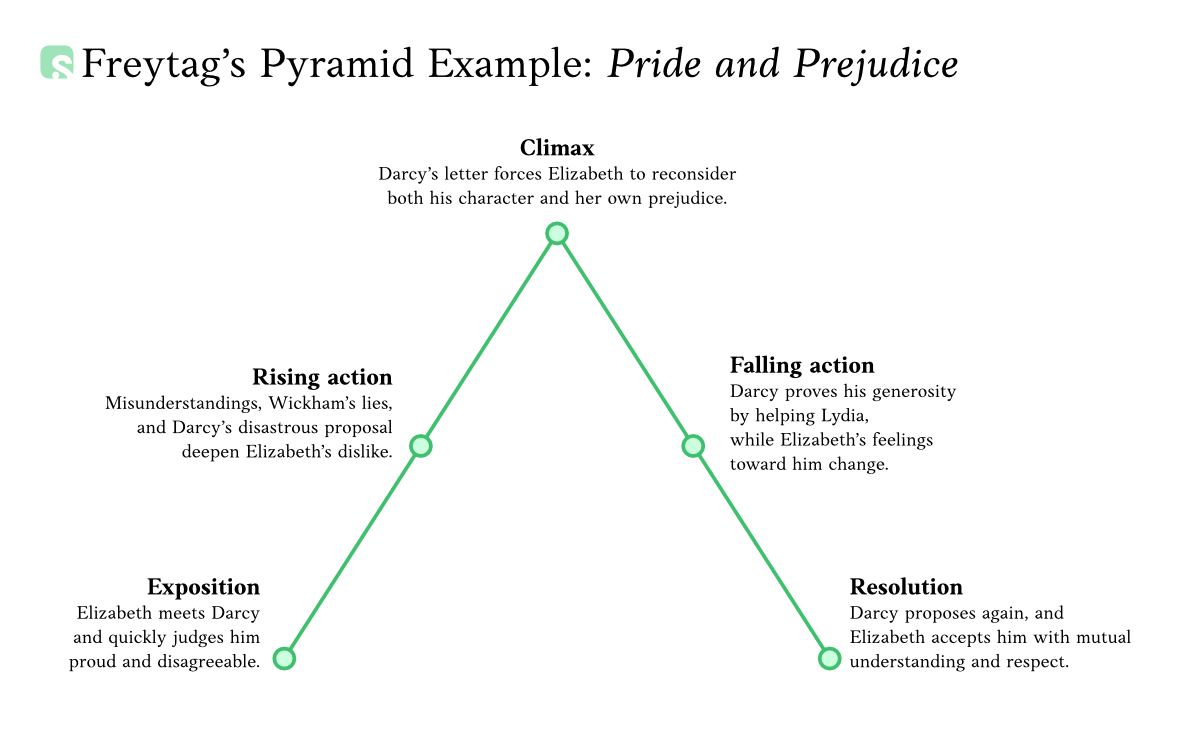
Freytag’s Pyramid Example: Pride and Prejudice
Jane Austen’s Pride and Prejudice, published in 1813, shows how Freytag’s pyramid can be applied to a novel.
The fit is not exact. Austen did not write according to Freytag’s model, and the novel contains several intertwined romantic and social conflicts. Even so, the framework reveals the broad movement of Elizabeth Bennet’s relationship with Mr. Darcy.
Exposition
The Bennet family has five unmarried daughters whose financial futures are uncertain because the family estate cannot pass to them.
The arrival of the wealthy Mr. Bingley creates an opportunity, particularly for Jane Bennet. At a local assembly, Elizabeth meets Mr. Darcy. His reserved manner and dismissive remark about her appearance create an immediate dislike.
The novel establishes its central conditions: marriage carries economic weight, social judgment shapes relationships, Jane and Bingley are attracted to one another, and Elizabeth believes Darcy to be proud and unpleasant.
Rising Action
Darcy becomes increasingly interested in Elizabeth, but she interprets his behavior as arrogance. Her dislike deepens when George Wickham claims that Darcy treated him unjustly.
Jane and Bingley grow closer, then Bingley abruptly leaves Netherfield. Elizabeth believes Darcy separated them.
Mr. Collins proposes to Elizabeth, offering security without affection or respect. She refuses. Darcy later proposes, but his declaration emphasizes the inferiority of her family. Elizabeth rejects him and accuses him of harming both Wickham and Jane.
The proposal brings the novel’s central conflicts together. Elizabeth believes she understands Darcy. Darcy believes his feelings should outweigh his contempt for her connections. Both are blinded by faulty judgment.
Climax
Darcy writes Elizabeth a letter explaining his actions.
He admits discouraging Bingley because he believed Jane was indifferent. He also reveals that Wickham attempted to elope with Darcy’s young sister for her fortune.
The letter creates the novel’s central reversal. Elizabeth realizes that wounded pride, prejudice, and confidence in her own judgment have distorted her understanding.
Nothing outwardly spectacular happens, but the story changes direction. Elizabeth begins judging both Darcy and herself more honestly.
Falling Action
Elizabeth visits Darcy’s estate at Pemberley and sees him in a different context. His housekeeper speaks warmly of him, and Darcy treats Elizabeth and her relatives with unexpected kindness.
Lydia Bennet’s elopement with Wickham then threatens the reputation of the entire family. Darcy secretly finds the couple, pays Wickham’s debts, and arranges their marriage.
His actions demonstrate genuine change. Instead of protecting his pride, he helps the Bennets without seeking recognition.
Bingley returns and proposes to Jane. Lady Catherine de Bourgh confronts Elizabeth and demands that she promise never to marry Darcy. Elizabeth refuses.
The remaining obstacles narrow as Elizabeth and Darcy prepare to act on what they have learned.
Resolution
Darcy proposes again. This time, the proposal is based on mutual respect rather than wounded pride or social superiority. Elizabeth accepts.
The external and internal conflicts resolve together. Darcy has confronted his pride. Elizabeth recognizes the danger of confident prejudice. Their changed behavior makes a successful relationship possible.
Alternatives to Freytag’s Pyramid
Three-Act Structure
Three-act structure divides a story into setup, confrontation, and resolution. It usually places major turning points at the act transitions and the final climax late in the third act.
Choose it when you want a flexible framework suited to modern commercial fiction.
Five-Act Structure
A modern five-act structure often divides the story into setup, complication, crisis, falling action, and resolution.
Choose it when the novel develops through several substantial movements and you need clearer section boundaries.
The Hero’s Journey
The Hero’s Journey follows a protagonist who leaves a familiar world, undergoes trials and transformation, and returns changed.
Choose it when the protagonist’s psychological, symbolic, or transformational journey matters more than the shape of the external conflict.
Save the Cat
Save the Cat uses detailed beats such as the catalyst, debate, midpoint, all-is-lost moment, and finale.
Choose it when you need specific pacing guidance for a commercial novel.
Seven-Point Story Structure
Seven-point structure organizes a story around major plot events, including two plot points, two pinch points, a midpoint, and a resolution.
Choose it when Freytag’s five stages feel too broad but a detailed beat sheet feels restrictive.
Fichtean Structure
Fichtean structure moves rapidly into conflict and develops through a succession of escalating crises.
Choose it for thrillers, mysteries, and other novels that benefit from immediate pressure and minimal opening exposition.
How to Use Freytag’s Pyramid to Plan a Novel
Do not begin by assigning every chapter to a stage. First identify the novel’s broad dramatic movement.
Write one or two sentences answering each group of questions.
Exposition
- Who is the protagonist?
- What is their starting situation?
- What event begins the central conflict?
Rising Action
- What does the protagonist try to achieve?
- What are the three or four most important complications?
- How do the stakes increase?
- Which decision makes the situation harder?
Climax
- What revelation, victory, defeat, or choice changes the story’s direction?
- Why can the protagonist not return to the previous situation?
Falling Action
- What consequences follow?
- What final problem must be faced?
- How do the major subplots converge?
Resolution
- How is the central conflict settled?
- What has changed externally?
- What has changed within the protagonist?
- What final image best expresses the new situation?
Inside a planning tool such as Scryla, these stages can be recorded as broad structural beats and linked to relevant chapters. That makes it easier to see whether the middle contains genuine escalation, whether the climax creates a reversal, and whether the ending leaves enough room for consequences.
The plan should clarify the novel rather than control it. A chapter may serve several structural purposes, and the shape of the story may change during drafting.
Final Thoughts
Freytag’s pyramid remains useful because it captures an enduring dramatic pattern: conflict begins, pressure increases, something decisive changes, and the consequences create a new state.
Its simplicity makes it accessible to beginners, but it also gives experienced writers a practical way to diagnose a slow middle, ineffective turning point, or abrupt ending.
Its value disappears when the diagram becomes a rule. Not every novel has one central peak. Not every climax occurs near the middle. Not every ending requires a long descent.
Use Freytag’s pyramid to ask sharper questions about escalation, reversal, and consequence. Then study other structures and choose the framework that best reveals the shape of the novel you are writing.