Hero's Journey Explained: The 12 Stages for Novelists
Learn the 12 stages of the hero's journey, where the structure came from, how to use it in a novel, and when another framework works better.
Read-aloud is not available in this browser.
The hero’s journey is one of the best-known story structures in fiction. At its simplest, it describes a character leaving familiar circumstances, entering unfamiliar territory, facing increasingly difficult trials, changing through those experiences, and emerging as someone capable of meeting the story’s central challenge.
Versions of this pattern appear in myths, folktales, fantasy novels, adventure stories, literary fiction, and film. But the hero’s journey is not a formula every story needs to follow. It is most useful as a framework for stories built around change through experience.
For novelists, that is its real strength: it connects external events to the protagonist’s internal arc. Instead of asking only, “What happens next?” you also ask:
What must this character experience before they can become capable of facing the story’s central challenge?
History of the Hero’s Journey
The modern concept of the hero’s journey comes primarily from mythologist Joseph Campbell.
In his 1949 book The Hero with a Thousand Faces, Campbell compared myths and religious stories from different cultures and argued that many shared a broad underlying pattern. He called this pattern the monomyth.
Campbell’s version was considerably more complex than the structure most writers use today, but it centered on three broad movements:
- Departure — the hero leaves the familiar world.
- Initiation — the hero undergoes trials and transformation.
- Return — the hero brings something gained through the journey back into ordinary life.
Campbell was studying mythology, not creating a novel-planning template. The practical version familiar to modern writers came later.
Screenwriter and story consultant Christopher Vogler adapted Campbell’s ideas into a twelve-stage model through The Writer’s Journey. That version became especially influential because it translated an academic theory into a structure writers could apply directly to stories.
The twelve-stage model is the version we’ll use here.
Core Principles of the Hero’s Journey
Before examining the individual stages, it helps to understand the ideas holding them together.
The hero’s journey is about transformation
A hero’s journey is more than a sequence of adventures.
The protagonist usually begins with a limitation: fear, immaturity, false beliefs, lack of confidence, emotional isolation, or an inability to accept some difficult truth. The plot places pressure on that limitation until the character can no longer rely on their old way of functioning.
By the climax, they must make a choice or take an action the person from the opening chapters could not have managed.
That transformation is what gives the external plot emotional weight.
The hero crosses into an unfamiliar world
Hero’s journey stories usually contain a meaningful divide between the protagonist’s familiar circumstances and the world of the adventure.
Sometimes that divide is literal. Dorothy leaves Kansas for Oz in The Wonderful Wizard of Oz. Alice falls down a rabbit hole into Wonderland.
But the threshold can also be social, emotional, or professional. A protagonist might enter a war, a murder investigation, an unfamiliar social class, a political movement, or a relationship governed by rules they do not understand.
What matters is that their existing assumptions are no longer enough.
Trials prepare the hero for the climax
The middle of a hero’s journey should not become a random collection of obstacles.
Each significant challenge ought to reveal, test, or develop something the protagonist will eventually need.
If a character reaches the climax using exactly the same beliefs, skills, and emotional resources they had on page one, the journey has probably changed very little.
The hero brings something back
Traditionally, the hero returns with an “elixir”: treasure, healing, knowledge, wisdom, or something else that benefits the world they return to.
Modern novels often interpret this more broadly.
The protagonist may gain self-knowledge, repair a relationship, overcome a fear, expose the truth, or finally understand where they belong.
The essential point is that the journey leaves something behind.
See also: Save the Cat Writes a Novel
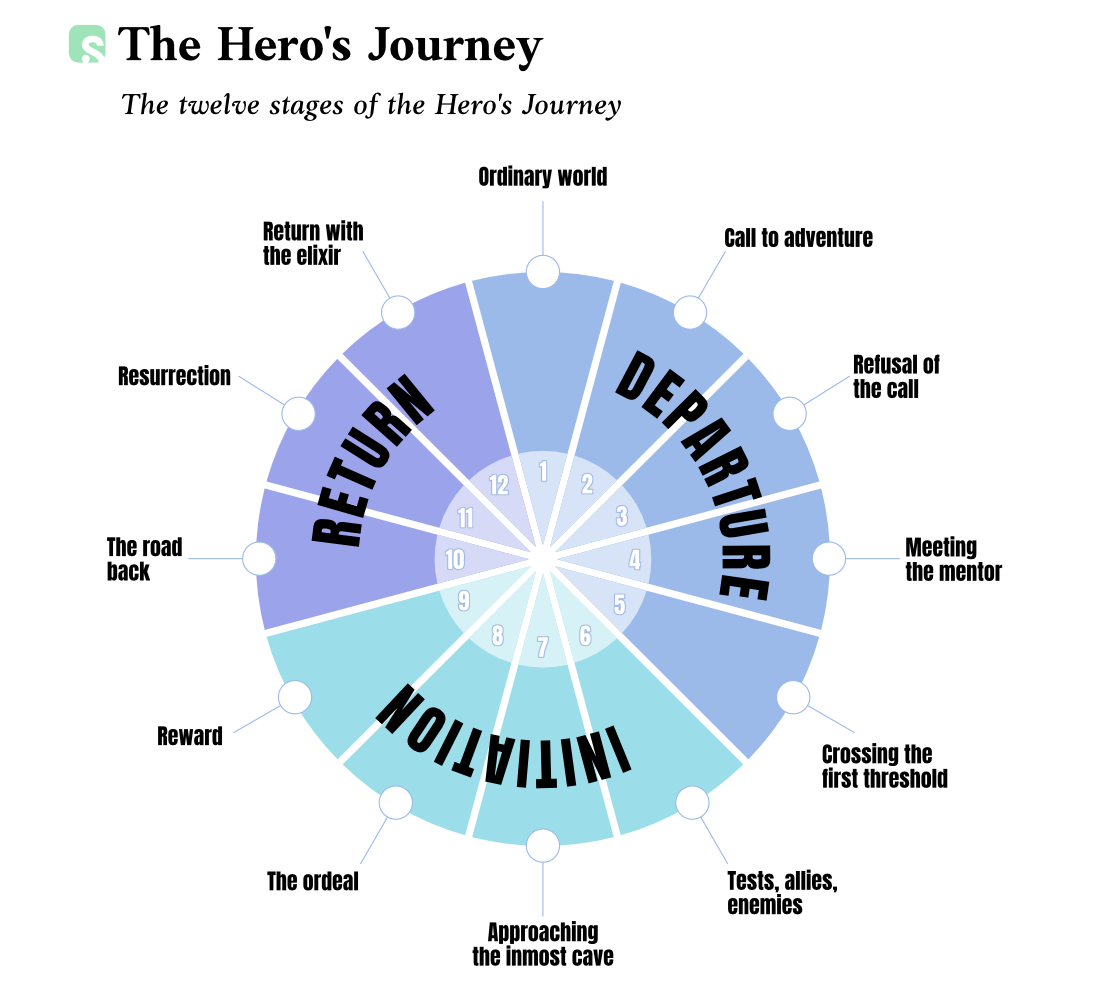
The 12 Stages of the Hero’s Journey
Treat these stages as narrative functions, not compulsory scenes. One stage might fill several chapters. Another may last a paragraph. Some stories combine stages or omit them altogether.
1. Ordinary World
The story establishes the protagonist’s life before the central adventure begins.
You do not need a complete biography. The purpose is contrast: show enough of normal life for readers to understand what will later be disrupted.
In The Wonderful Wizard of Oz, Dorothy’s gray Kansas home establishes the world she is about to leave.
Ask:
What does normal look like for this character before the story changes it?
2. Call to Adventure
Something disturbs that normality.
The call may take the form of a threat, invitation, discovery, opportunity, disappearance, mission, or crisis. Whatever form it takes, the existing situation can no longer continue unchanged.
In Alice’s Adventures in Wonderland, Alice’s pursuit of the White Rabbit carries her into an entirely different world.
The call starts the story moving.
3. Refusal of the Call
The protagonist resists what the adventure demands.
This does not require a literal refusal. A detective may accept a case immediately while privately believing they cannot solve it. A character may enter the new world physically while still resisting the emotional change it requires.
The purpose of this stage is to establish resistance to change.
Without resistance, transformation means very little.
4. Meeting the Mentor
The protagonist receives something that helps prepare them for what lies ahead: knowledge, equipment, encouragement, training, perspective, or a warning.
The mentor does not have to be an elderly sage. The function can be performed by a friend, rival, teacher, parent, former enemy, book, recording, or piece of information discovered by accident.
In The Wonderful Wizard of Oz, Dorothy receives guidance about how she may reach the Wizard and find a way home.
A mentor should equip the protagonist, not complete the journey for them.
5. Crossing the First Threshold
The protagonist commits to the adventure.
They move beyond considering the problem and begin living inside it. The premise of the story is now fully active.
After this point, an immediate return to normal should be difficult, impossible, or emotionally unacceptable.
Crossing the threshold tells the reader: we are really doing this now.
6. Tests, Allies, and Enemies
The protagonist learns how the unfamiliar world operates.
They encounter obstacles, form relationships, discover opponents, make mistakes, and test their abilities.
Dorothy’s journey along the yellow brick road provides a clear example. She meets the Scarecrow, Tin Woodman, and Cowardly Lion while encountering dangers that steadily complicate the journey to the Emerald City.
This stage often occupies a large portion of a novel’s middle, so escalation matters. Each test should deepen relationships, expose character, or prepare the protagonist for something harder.
7. Approach to the Inmost Cave
The protagonist moves toward a major confrontation.
The “cave” may be a literal place, but more often it represents whatever the hero most fears or is least prepared to face.
This stage may involve planning, gathering information, repairing relationships, resolving disagreements, or simply recognizing the seriousness of what lies ahead.
The important change is one of awareness: the protagonist knows a major test is coming.
8. Ordeal
The hero faces a major crisis.
Traditionally, this stage carries associations of symbolic death and rebirth. In a modern novel, it may take the form of a defeat, sacrifice, confrontation, betrayal, devastating discovery, or painful realization.
Something about the protagonist’s old way of functioning must fail.
The Ordeal often appears around the middle or later middle of the story, although its exact position varies.
What matters is its effect: the protagonist cannot emerge unchanged.
9. Reward
Having survived the Ordeal, the hero gains something.
That reward may be an object, evidence, knowledge, reconciliation, confidence, freedom, love, or a new understanding of themselves.
But this is not necessarily the ending.
The hero has gained something important. Now they must live with its consequences.
10. The Road Back
The story begins moving toward its final resolution.
Old problems may return. Enemies retaliate. A supposed victory proves incomplete. New information changes what the protagonist thought they understood.
This stage restores momentum after the Ordeal and points toward the climax.
The protagonist now knows more than they did before. The remaining question is whether they can act on that knowledge when it matters most.
11. Resurrection
The protagonist faces the story’s final and most important test.
The term “resurrection” reflects the idea that the hero’s former self has been replaced by someone changed by the journey.
In most interpretations, this is the climax.
The external conflict and internal arc should intersect here. A protagonist struggling with cowardice may finally have to act courageously. Someone who has refused to trust others may have to place their fate in another person’s hands.
Transformation stops being an idea and becomes a decision.
12. Return With the Elixir
The ending shows what remains after the journey.
The protagonist may literally return home, but physical return is not required. What matters is that their experiences have produced a lasting result.
Dorothy returns to Kansas with a changed understanding of the home she had wanted to leave.
A satisfying Return With the Elixir shows that the story mattered beyond simply defeating an antagonist or solving an immediate problem.
Hero’s Journey Example: The Wonderful Wizard of Oz
L. Frank Baum’s The Wonderful Wizard of Oz is a useful introductory example because the movement between ordinary and extraordinary worlds is so clear.
Ordinary World: Dorothy lives with Aunt Em and Uncle Henry in Kansas.
Call to Adventure: A cyclone carries Dorothy and her house away.
Refusal: Dorothy does not embrace Oz as a new life. Her overriding goal is to return home.
Mentor: The Good Witch of the North gives Dorothy guidance and directs her toward the Wizard in the Emerald City.
Crossing the Threshold: Dorothy begins following the yellow brick road through an unfamiliar world.
Tests, Allies, and Enemies: She encounters dangers while forming friendships with the Scarecrow, Tin Woodman, and Cowardly Lion.
Approach: Dorothy and her companions move toward increasingly dangerous encounters connected with the Wicked Witch.
Ordeal: Dorothy falls into the Witch’s power and faces a situation she cannot simply escape.
Reward: The Witch is defeated, allowing Dorothy and her companions to return to the Wizard.
Road Back: Their apparent solution collapses when the Wizard proves unable to send Dorothy home as promised.
Resurrection: Dorothy must abandon her reliance on the authority figure she believed would solve her problem.
Return With the Elixir: She returns to Kansas with a changed appreciation of home.
This example also shows why the hero’s journey should not be treated as a rigid scene list. One event can perform several structural functions, and reasonable interpretations may place individual moments differently.
The useful pattern is broader: departure, testing, transformation, and return.
Common Hero’s Journey Mistakes
Treating all twelve stages as mandatory
Forcing every stage into a manuscript usually makes the structure more visible than the story.
Use the hero’s journey diagnostically instead.
If the middle feels repetitive, “Tests, Allies, and Enemies” can prompt you to examine whether the challenges are genuinely escalating. If the climax feels emotionally hollow, “Resurrection” may reveal that the protagonist has never been forced to prove their transformation.
You do not need twelve perfectly labeled boxes.
Assuming the hero must literally travel
The journey can be psychological, social, professional, or emotional.
Crossing a threshold simply means entering circumstances where the protagonist’s existing assumptions no longer work.
Confusing the Ordeal with the climax
In the twelve-stage model, the Ordeal and Resurrection usually perform different jobs.
The Ordeal changes the hero.
The Resurrection tests that change.
Some novels combine both functions in one confrontation, but separating them can create a richer arc.
Making the mentor too powerful
A mentor should prepare the protagonist to act, not act on their behalf.
If a supporting character could solve the main conflict more effectively than the protagonist, readers may reasonably wonder why the hero is needed.
Copying the imagery instead of the function
You do not need a wizard, magical weapon, elderly teacher, dark cave, or literal return home.
Those are expressions of the framework, not requirements.
Look beneath the imagery and ask what each stage is doing for the story.
When the Hero’s Journey Is Not the Best Structure
The hero’s journey works particularly well for stories centered on an individual protagonist who undergoes substantial change. Other types of novels may benefit from a different framework.
Ensemble stories
Stories with several equally important protagonists may resist a single hero-centered arc.
Individual characters can still experience their own journeys, but another structure may describe the novel as a whole more cleanly.
Stories with static protagonists
Not every central character needs a major transformation.
Some detectives, comic protagonists, and adventure heroes remain comparatively stable while changing the people or circumstances around them.
Forcing an internal transformation onto such a character can weaken the very qualities that make the story work.
Tragedies
The hero’s journey can describe elements of some tragedies, but its emphasis on transformation and return may become awkward when the protagonist fails to learn, understands the truth too late, or causes their own destruction.
A structure designed around tragic progression may provide clearer guidance.
Experimental or nonlinear fiction
Stories built around fragmented chronology, multiple perspectives, thematic juxtaposition, or unconventional causality may gain little from being squeezed into a linear journey.
Structure should clarify your novel, not become a test it has to pass.
Alternatives to the Hero’s Journey
If the hero’s journey almost fits your story but not quite, another framework may be more useful.
Three-Act Structure
Three-Act Structure organizes a story broadly into setup, confrontation, and resolution.
It provides more flexibility and places less emphasis on a transformational hero arc.
See also: The Three-Act Structure Explained
Save the Cat
Save the Cat uses a more detailed sequence of story beats and offers clearer pacing checkpoints.
Writers who prefer concrete structural markers may find it easier to apply.
The Story Circle
Dan Harmon’s Story Circle condenses hero’s journey principles into eight stages involving desire, unfamiliar circumstances, adaptation, achievement, cost, and change.
It is useful when you like the underlying journey pattern but find twelve stages unnecessarily detailed.
Freytag’s Pyramid
Freytag’s Pyramid focuses primarily on dramatic escalation: rising action, climax, falling action, and resolution.
It may suit stories where the shape of the conflict matters more than a symbolic transformation arc.
See also: Freytag’s Pyramid: A Guide for Novelists
Final Thoughts
The hero’s journey has remained influential because the idea beneath it is simple and adaptable.
A character enters circumstances they are not prepared for. Familiar solutions stop working. Experience forces them to change. Eventually, they confront a challenge the person from the beginning of the novel could not have overcome.
That pattern can support an epic fantasy quest, a psychological drama, a coming-of-age story, or a novel in which the “journey” barely leaves a single room.
Use the hero’s journey when it helps you understand the relationship between plot and transformation. Combine stages, rearrange them, or leave them out when your story demands something different.
The best next step is not to force your current novel into twelve boxes. Instead, identify your protagonist’s starting point, the experience most likely to change them, and the final test that will reveal whether that change has taken hold. From there, you can decide whether the hero’s journey is genuinely the right framework—or whether another structure will serve the story better.