The Snowflake Method vs Save the Cat
Compare the Snowflake Method vs Save the Cat, including their stages, strengths, differences, examples, and which novel-planning method you should choose.

Read-aloud is not available in this browser.
Choosing a story-planning method can sometimes feel like planning the novel itself. One approach tells you to start with a sentence and gradually expand it into a complete book. Another gives you 15 structural beats and asks exactly when your protagonist’s life should go spectacularly wrong.
Both can work, but they each solve different problems.
The Snowflake Method vs Save the Cat comparison is therefore less about which framework is better and more about what you need help with. The Snowflake Method develops a novel from a simple premise into increasingly detailed characters, plot summaries, and scenes. Save the Cat focuses on the dramatic shape of the story: its pacing, turning points, and character transformation.
You can also combine them.
The History of the Snowflake Method and Save the Cat
Where the Snowflake Method came from
The Snowflake Method was created by novelist and theoretical physicist Randy Ingermanson. Drawing partly on his experience designing complex software systems, Ingermanson developed a process based on repeated expansion: start with something simple, add detail, then continue developing it until you have a workable novel plan.
The method contains ten steps, although Ingermanson now considers one optional. Its main purpose is organizational. Rather than imposing a fixed story shape, it helps turn the ideas in your head into a design you can actually write from.
Where Save the Cat came from
Hollywood screenwriter Blake Snyder introduced Save the Cat in his 2005 book Save the Cat! The Last Book on Screenwriting You’ll Ever Need. His framework organizes stories around 15 beats, beginning with the Opening Image and ending with the Final Image.
Novelist Jessica Brody later adapted the system specifically for fiction in Save the Cat! Writes a Novel. Although its roots are in screenwriting, the framework is now widely used by novelists interested in pacing, structure, and character change.
See also: Save the Cat Explained
Snowflake Method vs Save the Cat: The Core Difference
The simplest distinction is this:
The Snowflake Method is a process for developing a novel. Save the Cat is a framework for structuring one.
Snowflake asks:
What happens if I keep expanding this idea?
Save the Cat asks:
Where are the major changes in this story, and are they happening at effective points?
That distinction matters. Snowflake covers character development, synopses, scene planning, and eventually drafting. Save the Cat concentrates more narrowly on the dramatic journey.
If you have a promising premise but little idea how it becomes an entire novel, Snowflake may be more useful. If you understand your characters and premise but the plot feels flat, rushed, or shapeless, Save the Cat may offer the stronger diagnostic tool.
How the Snowflake Method Works
The Snowflake Method develops a novel through ten increasingly detailed stages. You are expected to revise earlier stages when later discoveries change the story.
Step 1: Write a one-sentence summary
Reduce the novel to a single sentence.
For Pride and Prejudice, you might write:
A proud young woman repeatedly misjudges an equally proud gentleman before discovering that both must change.
The exercise forces you to identify the central character, conflict, and direction of the story.
Step 2: Expand it into a paragraph
Turn that sentence into a short summary covering the setup, three major disasters, and the ending.
The aim is not to squeeze every subplot into five sentences. You are identifying the major movements that carry the story from beginning to end.
Step 3: Summarize the major characters
Create a short profile for each important character, including their motivation, goal, conflict, character change, and personal storyline.
This is one of Snowflake’s strengths: characters develop alongside the plot rather than being attached to it afterward.
Step 4: Expand the plot summary
Turn each sentence from your paragraph into a paragraph of its own.
The initial concept now begins to resemble a short synopsis.
Step 5: Expand the character stories
Summarize the novel from each major character’s perspective.
This can expose conflicts a plot-only outline misses. Two characters may participate in exactly the same events while believing they are living through completely different stories.
Step 6: Develop a longer synopsis
Expand the plot outline into several pages.
Cause and effect should now become clearer. Instead of simply recording what happens, examine why each event leads to the next.
Step 7: Build detailed character profiles
Develop the histories, motivations, goals, conflicts, and eventual changes of your important characters.
Record what affects the novel. You probably do not need to document every childhood birthday party unless one of them ended in a suspicious disappearance.
Step 8: Create the scene list
Break the synopsis into individual scenes.
Ingermanson originally recommends using a spreadsheet containing details such as viewpoint character and scene events. The format is less important than the purpose: converting an abstract outline into scenes you can write.
Step 9: Expand individual scenes
Write more detailed scene descriptions if you find them useful.
Ingermanson now considers this step optional and no longer uses it himself.
Step 10: Write the novel
With the major structural problems addressed, begin drafting.
The outline is not a contract. Snowflake planning documents can continue changing as the draft reveals better possibilities.
How Save the Cat Works
Save the Cat divides a story into 15 beats across three broad acts. Many beats are associated with approximate positions within the story, giving writers a way to assess pacing as well as structure.
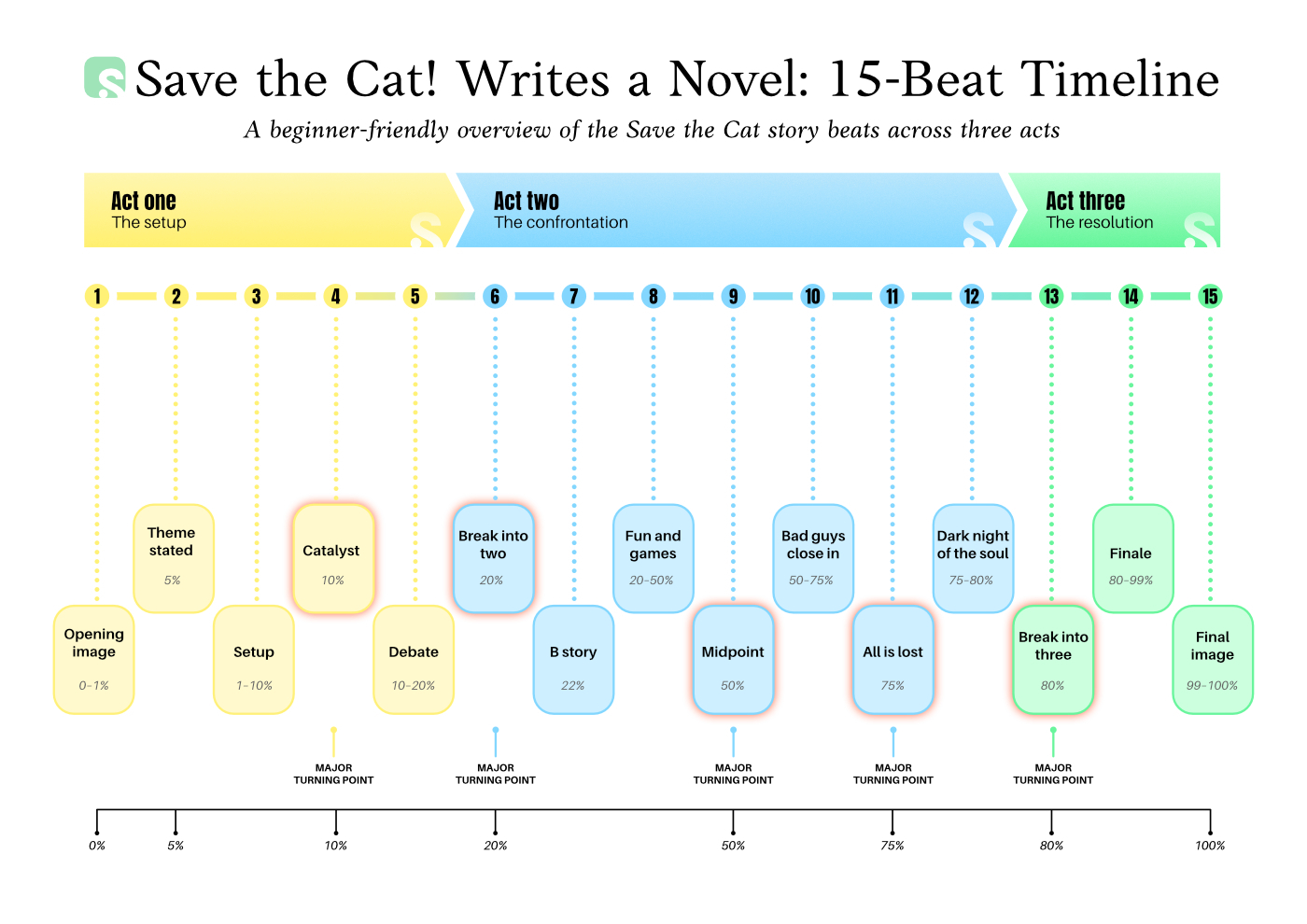
Act One: Establish the problem
Opening Image: Show the protagonist’s life before the story changes them.
Theme Stated: Introduce an idea or truth the protagonist will eventually need to understand.
Setup: Establish the protagonist’s everyday world, flaws, relationships, and unresolved problems.
Catalyst: Disrupt normal life.
Debate: Give the protagonist space to react, hesitate, prepare, or question what comes next.
Act Two: Challenge the protagonist
Break into Two: The protagonist actively enters the main conflict or a new situation.
B Story: Introduce a secondary relationship or storyline that often develops the theme.
Fun and Games: Deliver the promise of the premise. In a detective novel, this might mean pursuing suspects and uncovering clues. In a survival story, it might mean increasingly desperate attempts to stay alive.
Midpoint: Create a significant victory, defeat, or revelation that raises the stakes.
Bad Guys Close In: Increase both internal and external pressure.
All Is Lost: Bring the protagonist to apparent defeat.
Dark Night of the Soul: Allow them to process the failure and recognize what must change.
Act Three: Resolve the transformation
Break into Three: New understanding provides the basis for a solution.
Finale: The protagonist applies what they have learned during the final conflict.
Final Image: Show how the protagonist or their world differs from the Opening Image.
Save the Cat gives you structural landmarks. It does not tell you how to turn those landmarks into fifty or eighty individual scenes. That part remains yours.
Snowflake Method vs Save the Cat: Pride and Prejudice
Imagine, if you will, that Jane Austen applied both frameworks in her planning stages.
Pride and Prejudice through the Snowflake Method
A Snowflake-style starting sentence might be:
A prejudiced young woman rejects a proud wealthy man before discovering that both her judgment and his behavior must change.
Expand it and the broad progression emerges: Elizabeth meets Darcy and dislikes him; Wickham confirms her suspicions; Darcy proposes disastrously; his letter challenges her assumptions; Lydia’s scandal threatens the Bennet family; Darcy intervenes; and Elizabeth eventually recognizes both his change and her own mistakes.
Character summaries then reveal competing goals. Elizabeth wants independence and a marriage she can respect. Darcy wants Elizabeth but initially views her family through the assumptions of his social class. Jane and Bingley provide another perspective on pride, interference, and misjudgment.
Snowflake would continue expanding these interconnected stories until they could be broken into scenes.
Pride and Prejudice through Save the Cat
Save the Cat draws attention to different features.
The Opening Image and Setup establish the Bennet family’s marriage problem and Elizabeth’s social world. Darcy’s arrival helps create the disruption that drives the central relationship.
Darcy’s first proposal works particularly well as a Midpoint reversal. What could have been romantic success instead exposes everything wrong with their relationship. His letter then destabilizes Elizabeth’s certainty about both Darcy and Wickham.
Lydia’s elopement creates an All Is Lost crisis, threatening the Bennet family’s reputation and apparently ending Elizabeth’s chances with Darcy. Darcy’s intervention and Elizabeth’s changed understanding lead toward the final reconciliation.
Snowflake shows how the story could be developed. Save the Cat highlights how its major turning points function.
Common Snowflake Method and Save the Cat Mistakes
“Snowflake means planning every detail before writing”
It can become extremely detailed, but it does not have to. Step 9 is optional, and Ingermanson encourages writers to revise their planning documents during drafting.
“Every Save the Cat beat must happen on an exact page”
The suggested percentages are guides, not magical coordinates. Moving your Midpoint slightly will not cause the storytelling police to rappel through your office window.
What matters is proportion. If your setup consumes half the novel and the climax appears six pages before the end, you may have a pacing problem.
“Fun and Games means comedy”
It means delivering what the premise promised.
A murder mystery needs investigation, suspects, clues, and complications. A locked-room thriller needs escalating attempts to understand or escape the trap. None of this has to be funny.
“Save the Cat makes novels formulaic”
It can if you treat the beats as mandatory plot events rather than dramatic functions.
A Catalyst might be a corpse discovered in a hotel room, an unexpected marriage proposal, a redundancy notice, or a portal opening behind the refrigerator. The framework defines the job of the beat, not its contents.
“I have to choose one”
You don’t.
One practical hybrid is to identify the broad Save the Cat beats first and then use Snowflake-style expansion to develop the characters, subplots, synopsis, and scenes between them.
Scryla’s story frameworks and scene-level planning can be used in the same way: structural landmarks can guide the outline without dictating every scene.
When Not to Use the Snowflake Method or Save the Cat
Neither approach suits every writer or novel.
The Snowflake Method may frustrate you if discovering the story through drafting is central to your process. Repeated expansion can eventually feel like writing increasingly elaborate summaries of the novel you would rather be writing.
Save the Cat may be less helpful for fiction that deliberately avoids conventional escalation or protagonist transformation. Episodic, experimental, ensemble-driven, or fragmented novels may resist its 15-beat progression.
Most importantly, do not force a story into either framework simply because a diagram says something “should” happen.
Structure exists to help you understand your novel. Your novel does not exist to prove that the structure works.
Alternatives to Snowflake and Save the Cat
If neither method fits, you have plenty of alternatives.
Three-Act Structure provides broad structural guidance without prescribing many individual beats.
Story Circle follows a character who enters an unfamiliar situation, adapts, gets what they wanted, pays a price, returns, and changes.
Hero’s Journey suits stories centered on departure, trials, transformation, and return.
Freytag’s Pyramid emphasizes rising action toward a climax followed by falling action and resolution, although its original dramatic model does not map neatly onto every modern novel.
See also: Freytag’s Pyramid: A Guide for Novelists
You can also build a hybrid. Many writers eventually borrow the parts that help and quietly abandon those that do not.
Snowflake Method vs Save the Cat: Which Should You Choose?
Choose the Snowflake Method if your main challenge is turning a promising idea into a detailed, coherent novel plan.
Choose Save the Cat if you understand the story but need stronger pacing, turning points, or character transformation.
Combine them if you need both.
You might identify your major Save the Cat beats, summarize the novel in one Snowflake sentence, expand that sentence into a synopsis, develop the characters, and finally break the story into scenes.
There is no prize for following any framework perfectly. Use structure until it helps you see the novel more clearly. Then remain willing to change it when the story demands something better.
And, eventually, stop planning long enough to write the thing.