Save the Cat Writes a Novel Explained: A Beginner-Friendly Guide to the 15 Beats
Learn how Save the Cat Writes a Novel works with a clear explanation of all 15 beats, practical examples, common mistakes, and alternative story structures.

Read-aloud is not available in this browser.
You have a promising protagonist, a strong premise, and several scenes you can’t wait to write. What you don’t yet have is a complete story.
Perhaps the middle feels shapeless or the ending exists only as a vague confrontation. Or maybe you’ve written 30,000 words and realized that nothing is forcing your protagonist to change.
This is the problem Save the Cat! Writes a Novel is designed to solve.
Adapted for novelists by Jessica Brody, the framework divides a story into 15 major beats. Each beat performs a structural job, from establishing the protagonist’s ordinary life to pushing them through a crisis and showing how the experience has changed them.
The method is popular because it provides specific landmarks without requiring you to plan every scene in advance. It tells you what each major section of the novel needs to accomplish while leaving you free to decide how it happens.
The History of Save the Cat Writes a Novel
The framework began in screenwriting, not fiction.
Screenwriter Blake Snyder introduced the Save the Cat method in his 2005 book Save the Cat! The Last Book on Screenwriting You’ll Ever Need. Its best-known feature was the his beat sheet: 15 structural moments arranged across a conventional three-act story.
The unusual title referred to Snyder’s belief that a protagonist should do something early in the story that helps the audience understand or care about them. The character might literally save a cat, but the broader principle was to establish a meaningful connection between protagonist and audience.
The original method was designed for screenplays, where page counts and running times create relatively strict pacing expectations.
Jessica Brody later adapted the system in Save the Cat! Writes a Novel, published in 2018. Her version retained Snyder’s 15 beats while translating them into tools better suited to novel-length storytelling.
What Problem Does Save the Cat Solve?
“Beginning, middle, and end” may describe a structure, but it offers little practical help when you’re staring at an unfinished outline.
Save the Cat addresses several common plotting problems.
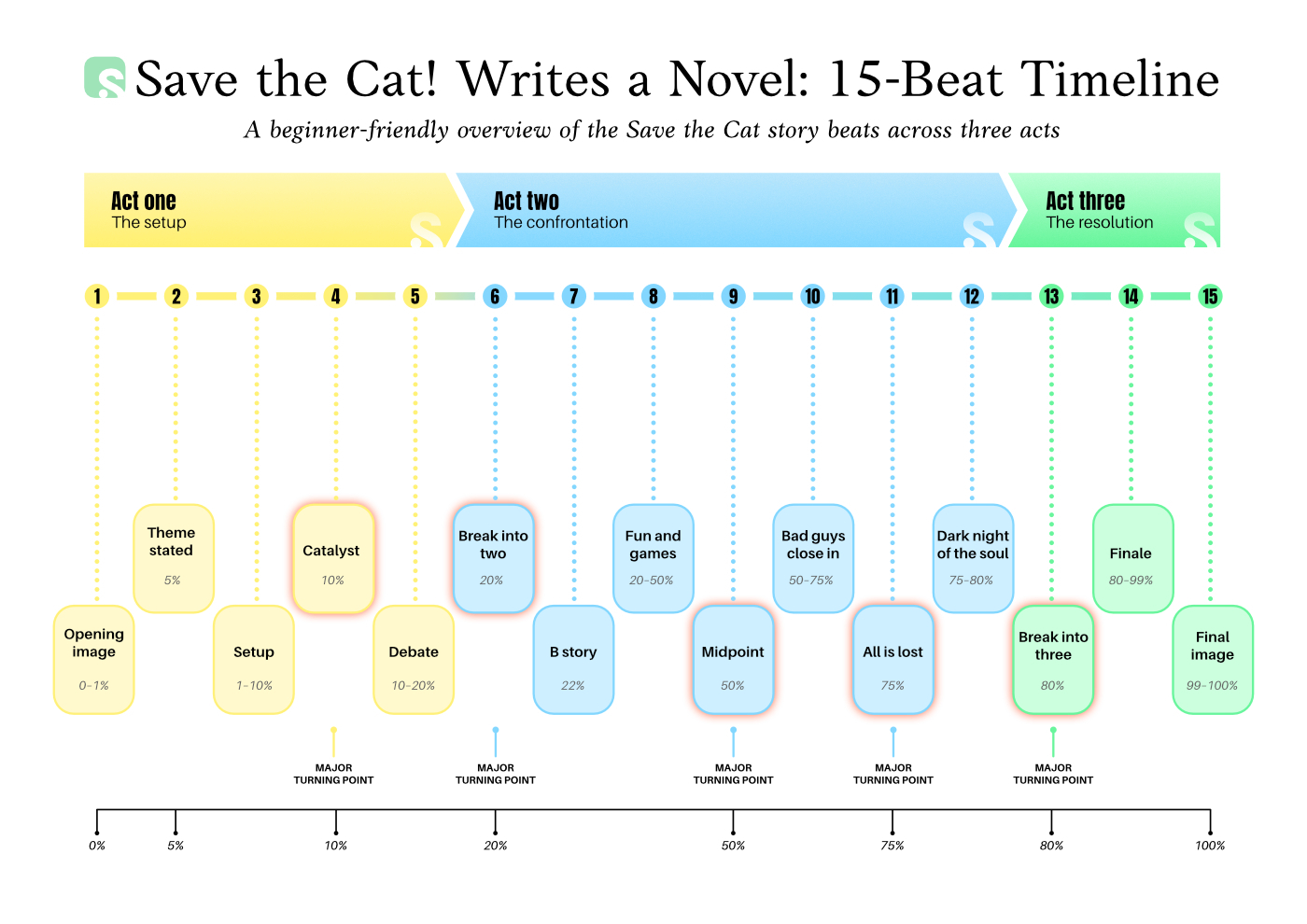
We have a save the cat beat sheet template below.
It Gives the Middle of the Novel a Shape
Many authors can imagine an arresting opening and a dramatic ending. The middle becomes a loose collection of obstacles, conversations, revelations, and side quests.
Save the Cat divides that middle into distinct phases. First, the protagonist explores the new situation and experiences the promise of the premise. At the Midpoint, the meaning or direction of the story changes. Pressure then increases until the protagonist’s original strategy fails completely.
See also: Save the Cat vs Three-Act Structure
See also: The Snowflake Method vs Save the Cat
It Connects Plot to Character Development
Escalating events do not automatically create a satisfying story.
The external conflict should challenge something inside the protagonist: a fear, wound, misconception, defensive habit, or incomplete understanding of themselves.
Save the Cat repeatedly asks four useful questions:
- What does the protagonist want?
- What do they actually need?
- Why can they not succeed while remaining the person they are at the beginning?
- What must they understand or change before the ending?
A musician might want to win a prestigious audition but needs to stop measuring his worth through applause. A prince might want to reclaim a throne but needs to understand that ruling is an obligation not a reward.
It Provides Pacing Landmarks
The framework suggests approximate positions for major events, usually expressed as percentages rather than fixed page numbers.
These landmarks can expose structural imbalances. You may discover that the central disruption doesn’t occur until a quarter of the way through the novel, leaving the opening overextended. Alternatively, the protagonist may reach their lowest point and recover within two hurried chapters.
The percentages don’t determine whether a novel works, but they do help you identify sections worth examining.
The Core Principles of Save the Cat! Writes a Novel
Before examining the individual beats, it helps to understand the ideas holding the framework together.
Story Structure Is Built Around Change
The protagonist should not simply defeat an antagonist or complete a mission. They should emerge with a different understanding of themselves, other people, or the world.
That transformation may be positive, negative, tragic, incomplete, or deliberately resisted. What matters is that the events test the protagonist’s original worldview.
A positive arc might show a guarded protagonist learning to trust. A tragic arc might show someone repeatedly rejecting the truth until their worst belief consumes them. In both cases, plot and character change are inseparable.
The Protagonist Has a Want and a Need
The want is the visible goal.
A detective wants to identify a murderer. A chef wants to save her restaurant. A teenager wants to escape an isolated island.
The need is the internal change required for meaningful success.
The detective needs to stop working alone. The chef needs to accept that preserving the restaurant is not worth sacrificing every relationship. The teenager needs to stop waiting for someone else to rescue them.
The protagonist usually begins by pursuing the want through the beliefs and habits they already possess. The story gradually demonstrates why that approach is inadequate.
The A Story and B Story Work Together
The A Story is the main external plot: the investigation, romance, competition, rebellion, survival problem, or quest.
The B Story is usually a relationship or secondary thread that helps the protagonist explore the theme. It may involve a friend, mentor, sibling, rival, romantic interest, or unexpected ally.
The B Story should not feel like an unrelated subplot inserted to fill space. It provides something the protagonist can’t learn through the main conflict alone.
A detective may gather evidence through the A Story but learn how to trust through her B-story relationship with a witness. A prince may fight a rebellion in the A Story while his B-story friendship with a servant forces him to question what leadership means.
Lessons developed through the B Story often become essential during the Finale.
Beat Percentages Are Guides, Not Laws
Save the Cat assigns approximate positions to its major beats. These can help identify pacing problems, but they shouldn’t be treated as deadlines.
A 100,000-word novel doesn’t become structurally defective because its Catalyst appears at 12,000 words rather than 10,000.
The real question is whether the beat performs its function at the right point in the reader’s experience. Has enough been established for the disruption to matter? Has the story spent so long preparing to begin that momentum has stalled?
Save the Cat Writes a Novel: The 15 Beats Explained
Act One: The Protagonist’s Existing World
1. Opening Image (approx. 0–1%)
The Opening Image gives readers a snapshot of the protagonist before the story changes them. It should establish the tone, reveal their starting condition, and create something the Final Image can later echo or contrast. Focus on behavior rather than explanation: a paramedic refusing help, for example, can demonstrate both competence and the flaw that will later cause trouble.
2. Theme Stated (approx. 5%)
The Theme Stated introduces the central idea the protagonist will eventually need to understand, often through a warning, question, accusation, joke, or piece of unwanted advice. The protagonist usually dismisses or misunderstands it because they’re not yet ready to accept the truth. The best thematic statements begin an argument that the rest of the novel will test rather than announcing a simple moral.
3. Setup (approx. 1-10%)
The Setup introduces the protagonist’s ordinary world, important relationships, immediate goals, and existing problems. Its main purpose is to show what is not working, whether that is a damaged relationship, a false belief, an unhealthy coping mechanism, or a goal pursued for the wrong reason. Include only the backstory readers need to understand the present situation and why it can’t continue unchanged.
4. Catalyst (approx. 10%)
The Catalyst disrupts the protagonist’s existing life and makes the old situation impossible to maintain. It might be a murder, breakup, job offer, disappearance, diagnosis, supernatural discovery, or any other event that demands a response. Whatever form it takes, it must affect something the protagonist personally values rather than functioning as distant background information.
5. Debate (approx. 10-20%)
During the Debate, the protagonist reacts to the Catalyst by hesitating, investigating, resisting, preparing, or searching for a safer alternative. The central question is usually some version of, “Can I do this, and should I?” This section gives the coming decision emotional weight, but it needn’t make the protagonist passive. By its end, remaining in the old world should no longer be a realistic option.
Act Two, Part One: Entering a New World
6. Break into Two (approx. 20%)
Break into Two occurs when the protagonist makes a meaningful choice that commits them to the central conflict and moves the story into the second act. They enter an unfamiliar situation governed by new rules, but they bring the same incomplete beliefs and habits they had in Act One. That mismatch between the protagonist and the new world creates much of the trouble ahead.
7. B Story (approx. 22%)
The B Story introduces or strengthens a relationship that helps explore the novel’s theme. It may involve a romantic interest, friend, mentor, rival, sibling, or unexpected ally who challenges the protagonist’s beliefs or exposes their defenses. This thread should influence the main plot rather than run beside it, because what the protagonist learns through the relationship often becomes essential during the Finale.
8. Fun and Games (approx. 20-50%)
Fun and Games delivers the central promise of the premise: the investigation in a mystery, the magical lessons in a fantasy, the growing attraction in a romance, or the escalating dangers in a survival thriller. These scenes don’t have to be cheerful; they simply provide the experience readers came for. Each sequence should also complicate the conflict, reveal character, establish a payoff, or create consequences for the second half.
9. Midpoint (approx. 50%)
The Midpoint changes the direction, meaning, or scale of the story, often through a false victory or false defeat. It may raise the stakes, make the conflict personal, introduce urgency, connect the A Story and B Story, or reveal that the protagonist has misunderstood the problem. A larger action scene isn’t enough on its own; something must be true after the Midpoint that cannot easily become untrue again.
Act Two, Part Two: Pressure and Failure
10. Bad Guys Close In (approx. 50-75%)
After the Midpoint, pressure intensifies as external threats and the protagonist’s internal weaknesses begin reinforcing one another. The “bad guys” may be an antagonist, institution, natural danger, public suspicion, fear, pride, distrust, or the consequences of earlier choices. The protagonist can still make progress, but each gain should carry a cost, expose a deeper problem, or narrow their remaining options.
11. All Is Lost (approx. 75%)
All Is Lost is the story’s apparent defeat, where the protagonist loses something essential and their original strategy fails completely. The loss may involve a relationship, opportunity, identity, source of hope, or literal life. It should arise naturally from the pressures and choices already established rather than feeling like an arbitrary disaster inserted to force a low point.
12. Dark Night of the Soul (approx. 75-80%)
The Dark Night of the Soul gives the protagonist space to understand the emotional meaning of the defeat. They may grieve, withdraw, confess, reconsider the past, or finally recognize why their old approach failed. Their new insight should emerge from what the story has taught them, especially through the B Story, rather than arriving through a convenient speech or sudden change of heart.
13. Break into Three (approx. 80%)
Break into Three occurs when the protagonist finds a new way forward by combining lessons from the external plot and the B Story. They may ask for help, tell the truth, accept a sacrifice, reframe the mystery, or abandon the original goal. They are not suddenly flawless, but they are prepared to act from a more complete understanding as they enter the final test.
Act Three: Demonstrating Change
14. Finale (approx. 80-99%)
The Finale resolves the central conflict and proves whether the protagonist has changed. A strong climax does more than deliver the largest confrontation; it creates a problem the protagonist can’t solve using the habits and beliefs they relied on in Act One. The final result should come from earned knowledge, established relationships, and a transformed approach, whether that leads to victory or, in a tragic arc, a final rejection of the truth.
15. Final Image (approx. 99-100%)
The Final Image mirrors or contrasts with the Opening Image to show what has changed. A protagonist who began alone may now accept help, while one who watched from safety may now work beside others. The moment should dramatize the transformation rather than explain it, allowing readers to feel the difference between who the protagonist was at the beginning and who they have become.
Common Save the Cat Mistakes to Avoid
Treating the Beat Sheet as a Formula
The framework describes structural functions, not compulsory events.
Your Catalyst doesn’t have to be a death. Your B Story doesn’t have to be romantic. Your Midpoint doesn’t require a battle. Your All Is Lost beat doesn’t require the mentor to die.
Two novels can share the same underlying structure while differing completely in subject, plot, tone, style, and meaning.
Confusing Beats with Scenes
A beat is a structural development. It could occupy part of one scene, several scenes, or an entire sequence.
Theme Stated might be a single line. Fun and Games and Bad Guys Close In cover extended sections of the novel.
Assigning exactly one chapter to every beat usually creates artificial pacing.
Making the Protagonist Passive
The Catalyst may happen to the protagonist, but the Break into Two should usually involve a meaningful decision.
A character who is dragged through every transition can feel like a passenger in their own novel. Even when trapped, coerced, arrested, kidnapped, or conscripted, the protagonist should choose what they intend to do next.
Forgetting the Internal Arc
A writer can fill all 15 beats and still produce a flat story if the beats track events without tracking transformation.
Identify the belief driving the protagonist’s early decisions. Then make sure that belief contributes to the problems they face.
All Is Lost becomes more powerful when the protagonist recognizes that the failure was not simply bad luck. Their own limitations helped create it.
Solving the Finale with a Convenient Surprise
The solution should emerge from previous setups, earned knowledge, established abilities, relationships, and character development.
A surprise can still occur, but it should deepen or complicate the climax instead of replace the protagonist’s actions.
Conclusion
Save the Cat! Writes a Novel offers something more useful than a list of compulsory plot events. It provides a way to understand what each major section of a novel needs to accomplish.
The Opening Image establishes the protagonist’s starting condition. The Catalyst disrupts their life. Break into Two commits them to a new path. The Midpoint changes their understanding of the conflict. All Is Lost destroys their original approach. Break into Three introduces a better one. The Finale tests whether they can act on what they have learned.
When fleshing out your beat sheet, begin with those turning points rather than trying to complete all 15 beats at once.
Identify:
- The protagonist’s external goal
- The internal belief holding them back
- The event that disrupts their life
- The decision that commits them to the story
- The revelation or reversal at the Midpoint
- The failure that exposes their deepest problem
- The new understanding they carry into the Finale
- The final image that proves what has changed.
Once those elements are clear, place the remaining beats between them and begin developing scenes.